Im Not Funny Im Just Mean
Making people laugh is not rocket science. Information technology is (a kind of) science, though.

Anyone who's ever wondered precisely why their joke did not land has a patron saint in professor Peter McGraw, who has plumbed the depths of human behavior to determine what is funny and what is not. Forth with co-author Joel Warner, McGraw has explored comedy all over the world, from the sets of Tokyo'south bizarre game shows to Palestine's version of Sat Dark Live, and beyond. This exploration has resulted in a volume called The Humor Code, and a reasonable scientific explanation for why people laugh at sure things and not others.
"Sense of humour arises when something seems wrong, unsettling, or threatening (a kind of violation), only simultaneously seems okay, acceptable, or rubber," McGraw says. This thought makes upward his Benign Violation theory, and information technology serves as the engine driving the book. "A dirty joke trades on moral or social violations, merely it's only going to get a laugh if the person listening is liberated enough to consider risqué subjects okay." He adds, "Even tickling, which has long been a sticking point for other humor theories, fits perfectly. Tickling involves violating someone's physical space in a benign fashion. You can't tickle yourself because information technology isn't a violation. Nor will you express joy if a creepy stranger tries to tickle you, since nothing about that is benign."
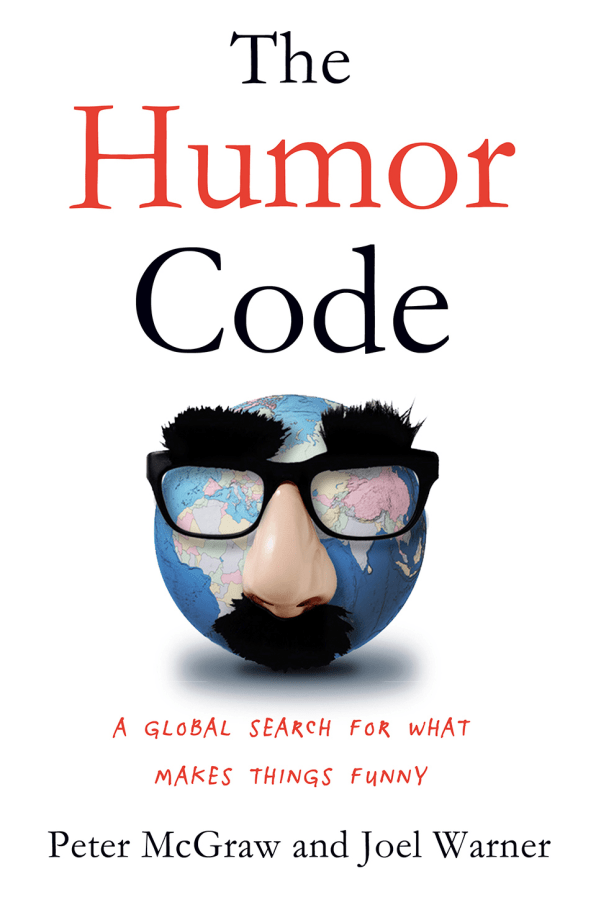
For his part, Warner posits a much simpler explanation about what makes something funny: farts. (Not all theories require heavy bookish enquiry.) The co-author first became interested in humor as a topic in 2010, when he caught current of air of McGraw's academically-sanctioned Sense of humor Research Lab (affectionately nicknamed Hurl). The professor had been at it for years, obsessed with uncovering why an anecdote he'd mentioned in a speech at Tulane fetched unlikely laughs from the crowd. One time Warner observed ane of McGraw's experiment in which participants picket Hot Tub Fourth dimension Machine while sitting at various locations in a room, he saw a story in McGraw's quest to find out, on a scientific level, what makes things laugh-worthy. The ii shortly joined forces.
McGraw adult his benign violation concept past modifying and expanding on an earlier linguist'south theory, one whose definitions didn't seem to cover the right bases. The professor has been conducting rigorous scientific testing at HuRL and in his travels with Warner always since, and thus far the concept has held water. Unlike other humor theories, such every bit superiority theory, incongruity theory, and relief theory, benign violation offers more explanations for why some things aren't funny.
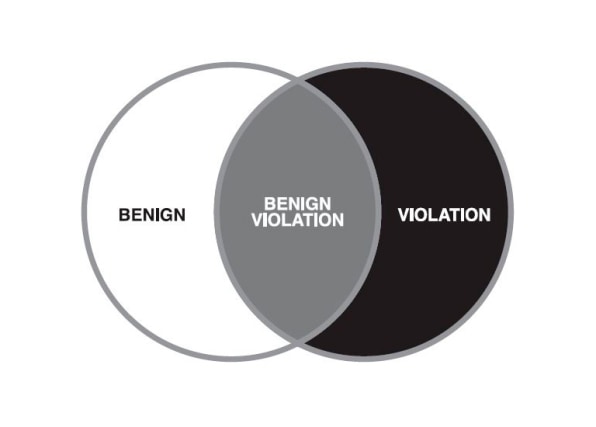
"A joke can fail in 1 of ii ways," he says. "It can exist also benign, and therefore boring, or it tin be too much of a violation, and therefore offensive."
The but manner for people who want to exist funny, perhaps professionally, to know the divergence is to arroyo their humor the way McGraw and Warner have: like scientists.

"It might not seem like it, but the best comedians hone their textile scientifically, by experimenting flake past bit," says Warner. "And the only way to learn is through hard, repetitive, empirical work. You become up in that location on that stage night after nighttime, judge which lines piece of work and which don't, and accommodate appropriately."
And if that doesn't piece of work, well, there's ever the farting pick.
Below, read through McGraw and Warner's explanations for whether a sampling of stand up-upward, movie, and sketch clips are funny.
#ane) Dumb & Dumber, peppers scene
We don't find this sort of gross slapstick particularly hilarious. (Nosotros, like all astute comedy aficionados, prefer to chuckle modestly at New Yorker cartoons while drinking cognac.) However, we will admit that wide, physical, and yes, stupid comedy like this has a pretty good shot at being funny all over the earth.
Have the work of British psychology professor Richard Wiseman. In 2001, Wiseman fix out to discover the globe's funnies joke. Over twelve months, his "LaughLab" website clocked 40,000 joke submissions and near 2 million ratings from people in 40 different countries–the largest-always scientific sense of humor written report. According to the results, this was the funniest joke:
"Two hunters are out in the forest when one of them collapses. He doesn't seem to be breathing and his eyes are glazed. The other guy whips out his phone and calls emergency services. He gasps, 'My friend is dead! What can I do?' The operator says, 'Calm down. I can aid. Offset, let's make sure he's expressionless.' There is a silence, then a gun shot. Back on the phone, the guy says, "Okay, at present what?'"
We met Wiseman in London, and he had nothing proficient to say about this zinger. "I think the globe's funniest joke isn't very funny," he grumbled. "It'due south terrible. I call up we plant the earth'southward cleanest, blandest, most internationally accepted joke. Information technology's the colour beige in joke form."
This makes sense. Universal comedy isn't going to exist the stuff that the most people notice hilarious, information technology'due south going to be the stuff that the least number of people find offensive. Any joke that makes fun of a item people, religion, occupation, or viewpoint isn't going to fly. Information technology has to be something that's acceptable to everybody–or in other words, something that'south a fleck stupid. And Dumb and Dumber is equally stupid as it gets.
#2) Tig Notaro's Taylor Dayne story
According to Pete'south benign violation theory, people tin can employ one of two strategies to meliorate their shtick: they can brand upsetting concepts more amusing by making them seem more beneficial (aka the Sarah Silverman Strategy, after the comedian who gets abroad with jokes on ballgame and AIDS considering the way she tells them is so darn beautiful), or they can point out what is hilariously incorrect with our benign, everyday concepts (aka the Seinfeld Strategy: "What's up with that airplane food?"). Tig Notaro is incredibly skilled in the Seinfeld Strategy, pointing out the applesauce in the stuff that most people have for granted.
Hither, she even uses the strategy to point out the absurdity of her ain routine: I've forgotten what to say next, and yet still you lot people are laughing! Why would I make up a story about a vocalizer none of you take heard of, that doesn't even have a expert punch line! Plus, Tig Notaro is magical. She makes everything funny. Have y'all seen the fleck where she does nada but button a stool across a stage, and still still the audience is loving it? In that example, art trumps science.
#3) Cardinal & Peele's E-West Basin sketch
Await, you want two geeky white guys to explain what makes a Key and Peele sketch involving convoluted African-American names funny? Fat take a chance. That, according to science, would be a pure violation. Please get us a grad educatee to figure information technology out for us.
Source: https://www.fastcompany.com/3028499/this-is-why-youre-not-funny-a-professors-scientific-approach-to-dissecting-humor
0 Response to "Im Not Funny Im Just Mean"
Post a Comment